Questions to Ask Your Dadi Before Her Stories Fade
Thoughtful questions to ask your dadi so her memories, language, recipes, faith, humor, and family history are not lost.
May 5, 2026 · 4 min read
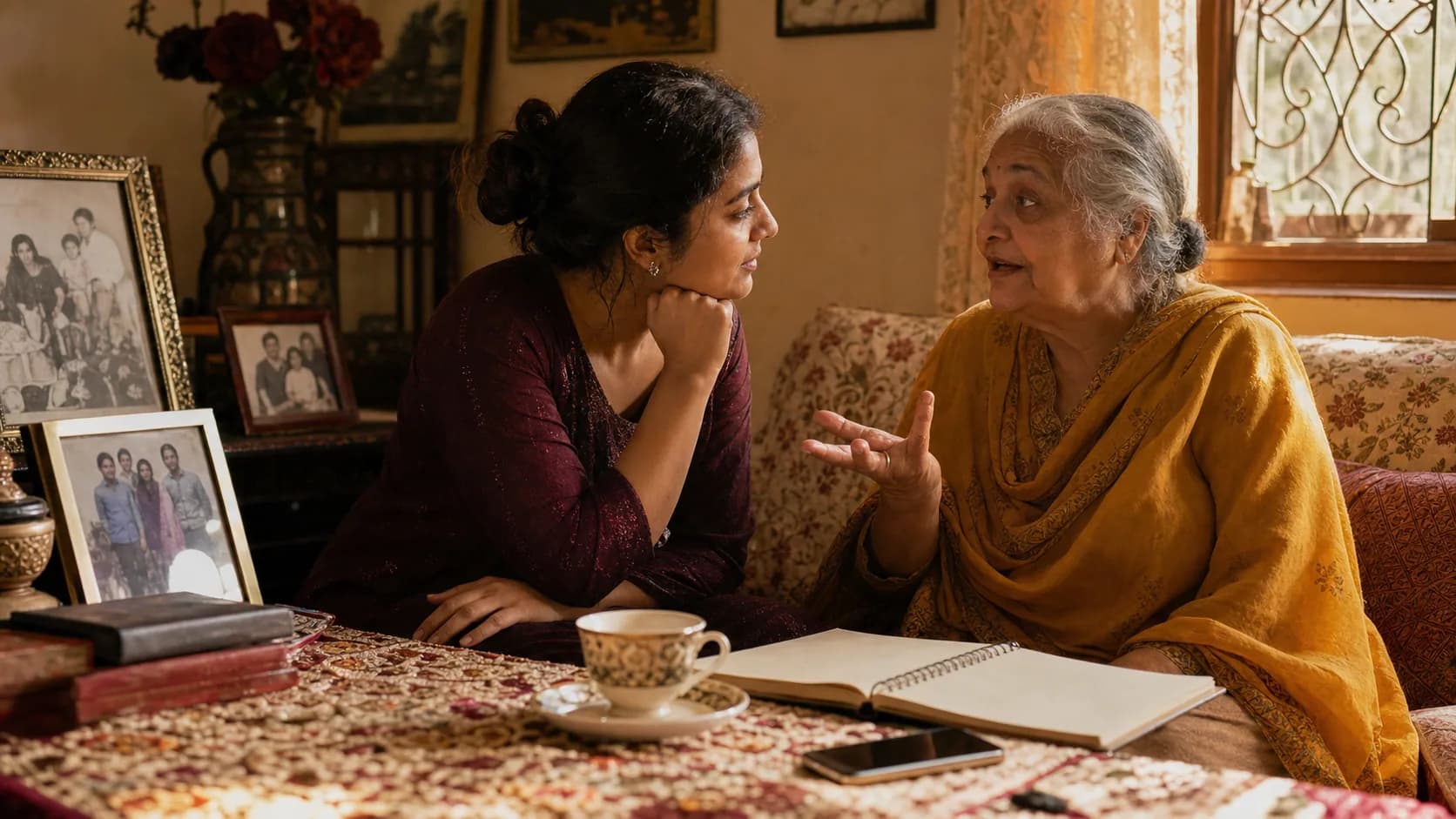
The best questions to ask your dadi are not always the biggest ones. Sometimes the most powerful question is small enough to answer over chai: "What did your childhood home smell like?" or "Who taught you how to make that recipe?"
Many South Asian families wait too long to ask. We assume Dadi's stories will always be there because she has told some of them before. But memory changes. Energy changes. Language changes across generations. The stories that feel ordinary to her may become priceless to you later.
Start with home
Home is often the easiest doorway into memory.
Ask your dadi:
- What was your first home like?
- Who lived with you when you were young?
- What sounds did you hear in the morning?
- What did the kitchen look like?
- Which room did everyone gather in?
These questions work because they do not demand a perfect timeline. They invite sensory memory: sound, smell, light, food, and people.
Ask about the women who shaped her
Many family histories preserve the names of men but forget the emotional labor of women. Ask about mothers, sisters, aunties, neighbors, teachers, and friends.
Try:
- Who taught you how to cook?
- Which woman in the family was the strongest?
- Who made you laugh when life was hard?
- What did your mother worry about?
- What advice did older women give you before marriage or motherhood?
These answers often reveal the hidden structure of a family.
Ask about migration and change gently
If your family carries Partition, migration, refugee, or diaspora memories, ask with care. Some stories are painful. Some are fragmented. Some may never have been spoken clearly.
You can begin softly:
- What do you remember about leaving one place for another?
- What did your family bring with them?
- What did they have to leave behind?
- Who helped you settle?
- What did you miss most?
Qissa's mission is built around preserving these voices with consent, privacy, and patience. You can read more about that approach on About Qissa.
Ask about language
Language carries family history. Ask your dadi about words that do not translate cleanly.
Try:
- What words did your parents use for love or discipline?
- Which sayings did elders repeat?
- What did people call you as a child?
- Which prayers, songs, or phrases do you want grandchildren to know?
- What does ghar mean to you?
Even a short answer can become a powerful bilingual page in a family book.
Ask about ordinary rituals
Do not only ask about major events. Ask about the everyday.
- What did Eid morning feel like?
- What did you cook when guests came suddenly?
- What did you wear to school?
- How did people announce good news?
- What did you do when someone was sick?
- What did your family do every Friday, Sunday, or festival day?
Ordinary rituals are often what grandchildren most want to inherit.
Record the answers while they are natural
You do not need a studio. You need a phone, a quiet moment, and one question. If your dadi prefers to speak instead of write, let her send a voice note. If she prefers Urdu, Hindi, Punjabi, Arabic, or a mix, let the story stay in that language first.
Qissa's process on How it Works is designed for exactly this kind of gentle collection. The finished book can preserve both the translated chapter and the original voice. You can see how those recordings sit beside the printed story on Inside the Book.
Start with one question this week. The rest of the archive can grow from there.
Read next
Keep building the family archive.
These guides connect the next question, recording habit, or heirloom idea so the archive feels easier to keep building.
September 17, 2026 · 10 min read
Family History Interview Consent: A Simple Guide
Learn how to ask for family history interview consent, set privacy boundaries, and preserve an elder's story with respect across languages and generations.
June 25, 2026 · 10 min read
How to Preserve Your Grandparents' Love Story Before It Fades
Your grandparents' love story, how they met and married, is fading. Learn how to preserve their courtship, wedding, and life together before it's lost.
June 13, 2026 · 10 min read
How to Preserve Your Family's Partition Stories
Learn how to gently ask your elders about 1947 Partition memories, preserve their voices, and pass these South Asian family stories to the next generation.
Preserve the voice too