
How to Turn Voice Notes Into a Family History Book
Voice notes can become a family history book when they are organized, transcribed, translated, edited, and paired with photos.
May 5, 2026 · 3 min read
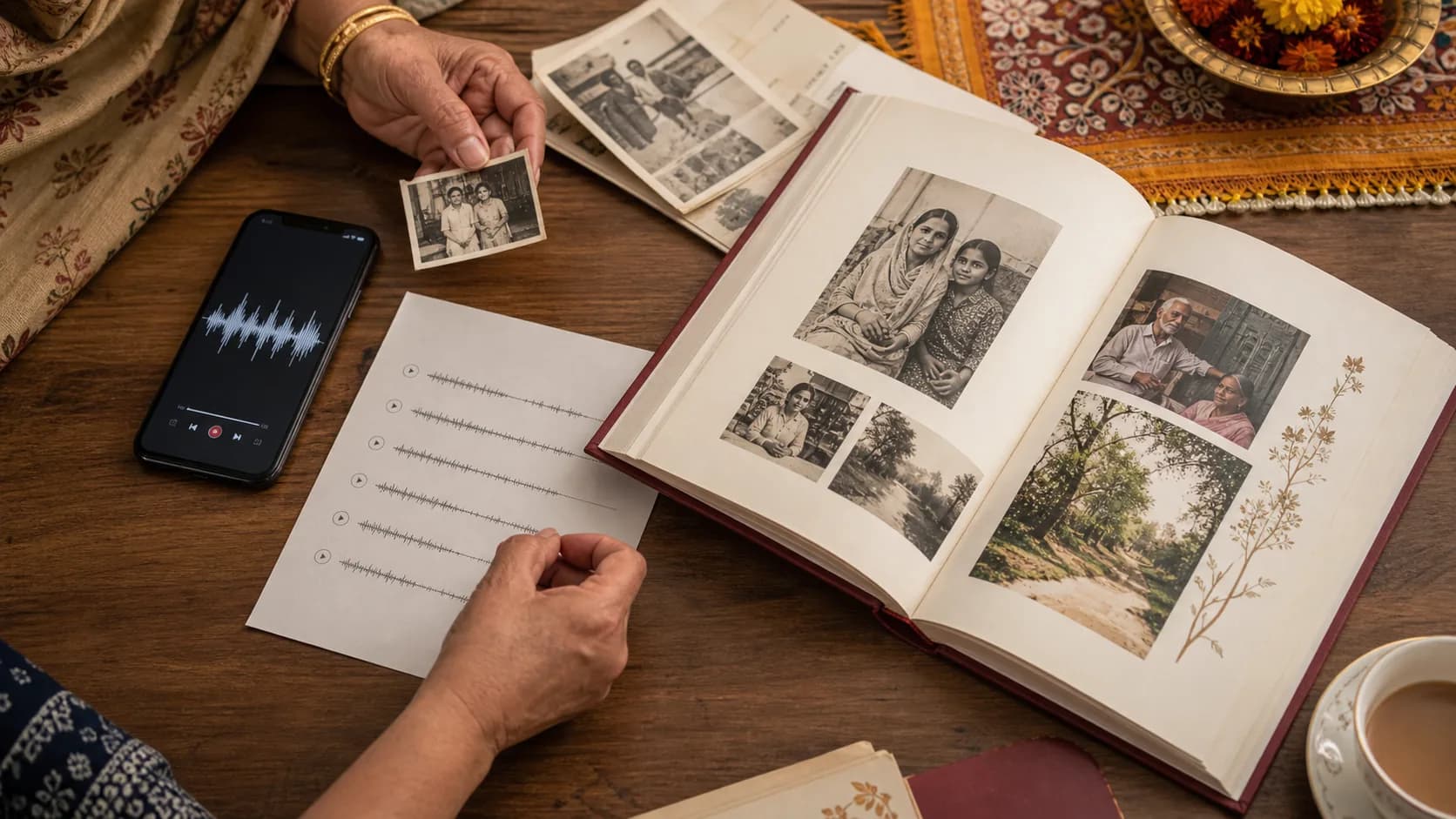
Voice notes can become a family history book when they are treated as raw family memory, not as files to forget in an old phone. The process is simple in idea: collect the recordings, organize them by theme, transcribe them, translate where needed, edit them into chapters, and pair them with photos.
For South Asian families, voice notes are often the easiest way to begin. A grandparent can speak in Urdu, Hindi, Punjabi, Arabic, English, or a mix. They can answer while sitting at home, after prayer, after tea, or when a memory comes back suddenly.
Step 1: Collect voice notes around specific prompts
Do not start with "Tell me your life story." Start with one question at a time.
Good prompts include:
- What did your childhood home feel like?
- What did your parents teach you without saying directly?
- What did you cook when guests arrived?
- What do you remember about moving from one place to another?
- Which family story should never be forgotten?
Specific prompts create specific recordings. Those recordings become easier to shape into chapters later.
Step 2: Save the recordings outside the chat
Message threads are fragile. Phones change. Apps get deleted. A proper archive should save each voice note with a clear title, date, storyteller name, and prompt.
Even a simple folder is better than leaving everything scattered. Use filenames like:
dadi-childhood-homenana-first-jobami-eid-recipesdada-migration-memory
The goal is to make the recordings findable.
Step 3: Transcribe in the original language first
If the voice note is in Urdu, Hindi, Punjabi, Arabic, or mixed English, preserve that first. Translation is useful, but it should not erase the original phrasing.
For example, a storyteller may say ghar when they mean more than "house." They may say dua when they mean prayer, blessing, and love at the same time. Keeping the original words gives the family history book emotional accuracy.
Step 4: Translate for the next generation
Many grandchildren need English alongside the original language. A bilingual family history book lets both generations meet on the page. Elders see their own words respected. Younger readers understand the story without losing the family vocabulary.
This is one reason Qissa's process includes transcription and translation. You can see the full journey on How it Works.
Step 5: Edit recordings into chapters
A transcript is not automatically a chapter. Spoken memories often loop, pause, repeat, or jump between years. Editing gives the story shape while preserving the storyteller's voice.
A chapter might become:
- "The House We Left Behind"
- "How I Learned to Cook"
- "The First Job"
- "Arriving in a New Country"
- "What I Want My Grandchildren to Know"
The chapter should sound like the storyteller, just clearer.
Step 6: Add photos and QR-linked audio
Photos make the chapter tangible. QR codes can make it audible. A printed page can hold the edited story, while a scan can open the original voice note.
That combination is powerful. The reader gets a polished family history book, but they can still hear the laugh, accent, pause, and emotion behind the memory. You can preview that experience on Inside the Book.
Voice notes are already family history. Turning them into a book simply gives them structure, safety, and a place in the family's future.
Read next
Keep building the family archive.
These guides connect the next question, recording habit, or heirloom idea so the archive feels easier to keep building.
May 7, 2026 · 9 min read
Family History Book Examples for Modern South Asian Families
See practical family history book examples for South Asian families, from voice-led elder stories to bilingual legacy books and QR audio archives.
May 5, 2026 · 3 min read
The Best Way to Record Your Grandparents' Stories
The best way to record grandparents' stories is to make the process familiar, gentle, voice-first, and easy to continue.
May 5, 2026 · 4 min read
Questions to Ask Your Dadi Before Her Stories Fade
Thoughtful questions to ask your dadi so her memories, language, recipes, faith, humor, and family history are not lost.
Preserve the voice too