Family History Book Examples for Modern South Asian Families
See practical family history book examples for South Asian families, from voice-led elder stories to bilingual legacy books and QR audio archives.
May 7, 2026 · 9 min read
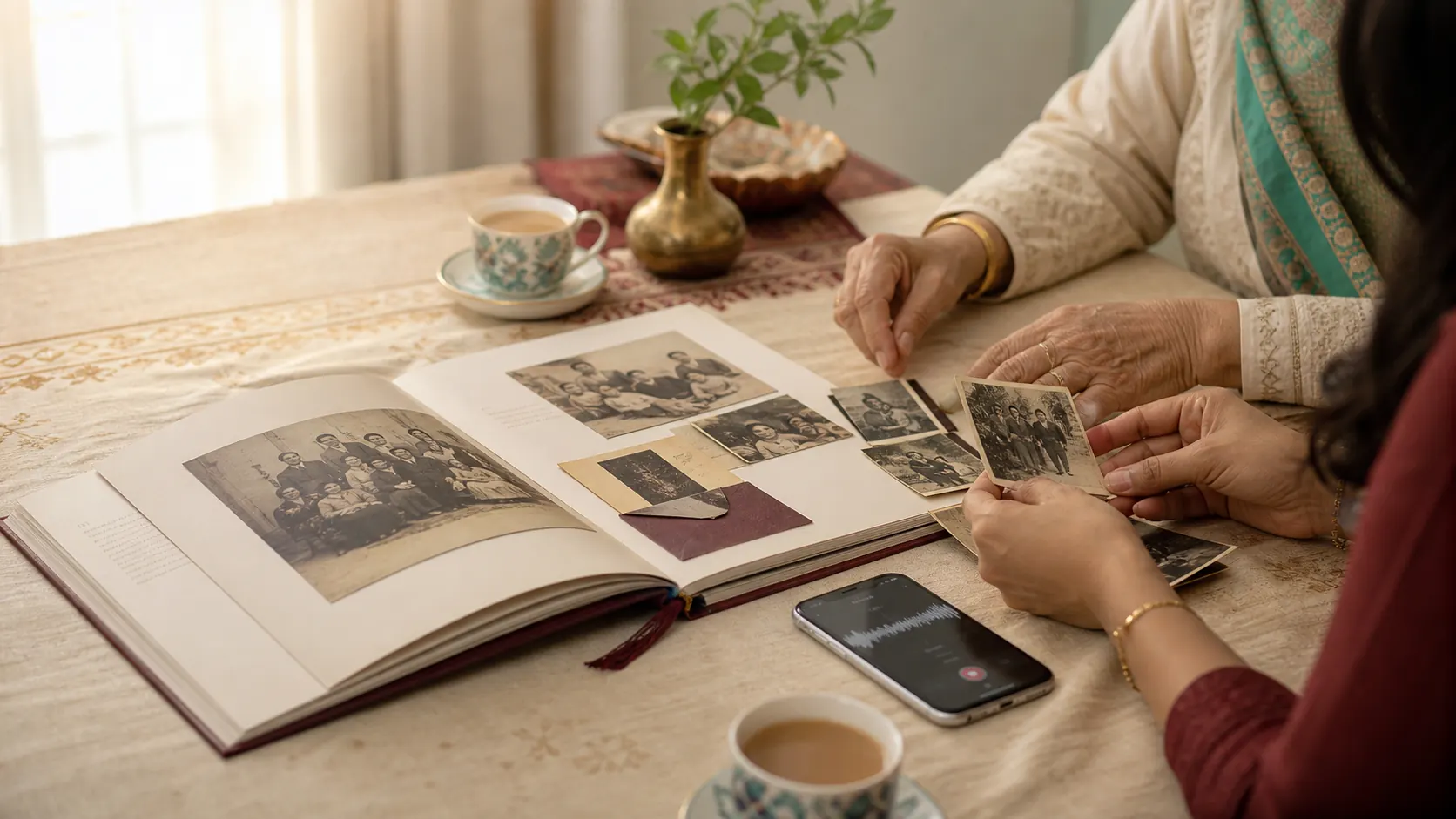
Family history book examples are useful because most families do not start with a neat archive. They start with a shoebox of photos, a WhatsApp voice note from Dadi, a half-remembered migration story, recipes nobody measures, and cousins spread across London, Toronto, Dubai, Karachi, Lahore, Delhi, New York, Sydney, and beyond. A good example shows how those fragments can become a book your family can read, hold, and pass down.
For South Asian families, the best family history book is rarely just a timeline. It is a bridge between languages, countries, generations, and memory styles. That is why Qissa builds family legacy books around voice, context, photographs, and bilingual storytelling.
Quick answer: what should family history book examples show?
The strongest family history book examples show a clear structure, not just beautiful pages. They help you decide whose story comes first, what belongs in the book, and how each chapter will feel to future readers.
A useful example should answer:
- Whose voice leads the book?
- Which photos need context?
- Which memories should stay in the storyteller's own words?
- Which languages should sit side by side?
- Which stories need audio, not only text?
The Smithsonian Institution Archives describes oral history as a way to preserve voices, memories, and perspectives through recorded interviews. That matters because a transcript can capture words, but a recording also keeps pauses, laughter, accents, and the details that make a person sound like themselves.
Example 1: the elder-led life story book
This is the best starting point when one parent, grandparent, or elder carries most of the family memory. Instead of trying to document everyone at once, the book follows one person's life in chapters.
A simple structure might look like this:
- Childhood home and family routines
- School, work, and early responsibilities
- Marriage, migration, or major turning points
- Parenting, faith, food, language, and family rituals
- Advice for children and grandchildren
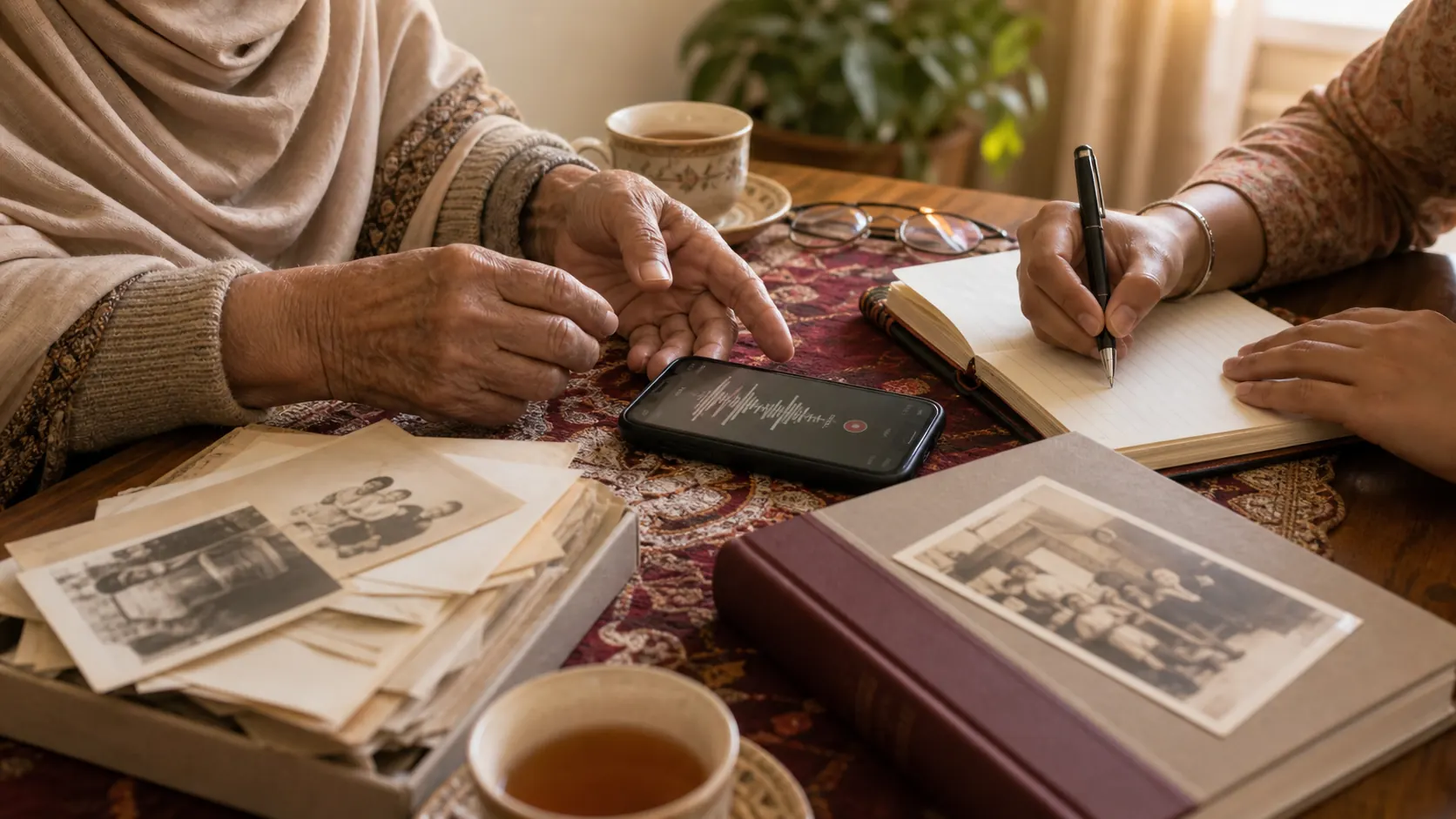
For a South Asian family, this kind of life story book works especially well when the storyteller is more comfortable speaking than writing. Qissa records guided phone or Google Meet sessions, so the process can feel less like an interview form and more like telling stories after chai.
Example 2: the photo-led family memory book
Some families do not begin with long stories. They begin with photographs: a wedding album from Karachi, a studio portrait from Lahore, a faded school photo from Nairobi, an Eid gathering in London, or grandparents standing outside their first home in Canada.
In a photo-led family memory book, each image becomes a prompt. The page does not simply say who is in the picture. It explains what the photo cannot show.
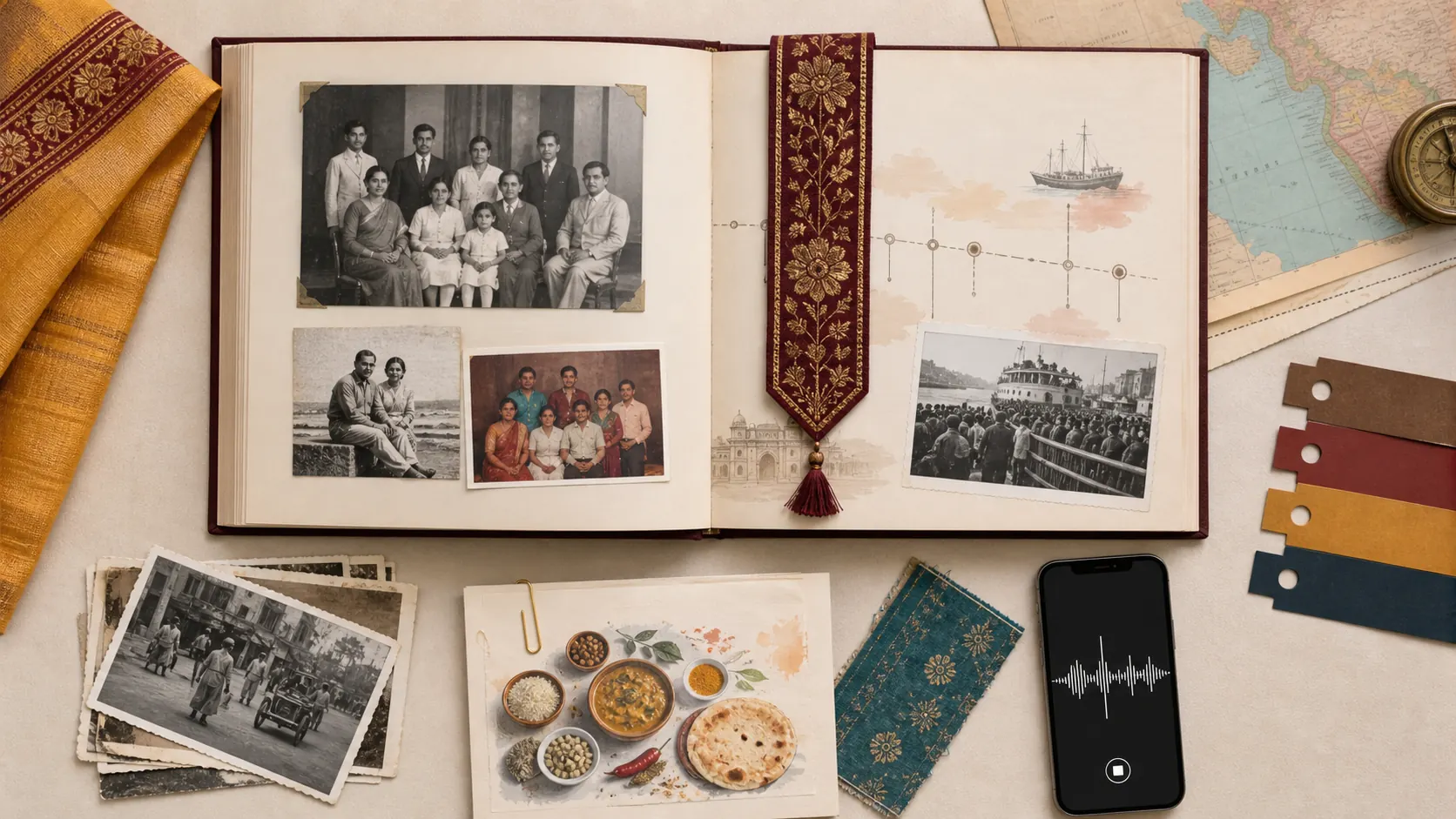
The caption might answer:
- Where was this taken?
- Who is missing from the photo?
- What happened before or after it?
- Why was this day important?
- Which words, jokes, or family sayings belong with this image?
This style works well for families who already have albums but feel the meaning fading. A photo album shows faces. A family history book explains the relationships, sacrifices, humor, and context behind those faces.
Example 3: the bilingual family history book
A bilingual family history book is one of the strongest formats for diaspora families. Many grandchildren speak English more comfortably than the language their grandparents use for emotional memories, but translating everything into English can flatten the story.
A better example keeps key words in the original language and explains them gently. If Dadi says sabr, dua, izzat, pind, mohalla, or beta, the book can keep those words where they carry feeling. The English text can explain enough for younger readers without removing the sound of the family.
This format is useful when elders answer in Urdu, Hindi, Punjabi, Bengali, Gujarati, Arabic, or mixed English, and grandchildren need context without losing the original voice.
The goal is to preserve meaning. A Qissa book can use bilingual layouts so the family does not have to choose between accuracy and accessibility.
Example 4: the migration or Partition chapter
Many South Asian families carry stories shaped by migration, Partition, war, political upheaval, new countries, or economic sacrifice. These chapters can be powerful, but they need care.
A good migration chapter does not force an elder to tell everything. It gives them control. It can include where they lived, what they carried, who helped them, what they missed, and what they rebuilt.
The Smithsonian Folklife and Oral History Interviewing Guide encourages interviewers to ask about family and community traditions, not only dates and events. That is useful here. Migration stories are also about food, clothing, work, letters, language, neighbors, holidays, and the first time a new place felt like home.
For sensitive memories, the best family history book example uses clear consent. The storyteller should know how the story will be used, who will read it, and what can stay private. Some families may choose a softer chapter that says enough for future generations without reopening every wound.
Example 5: the recipe, ritual, and everyday life book
Not every legacy is dramatic. Some of the most meaningful family memory book pages come from ordinary routines.
This example may include:
- the biryani method that was never written down
- how Eid mornings felt in the old house
- family rules about guests, tea, school, or respect
- songs, sayings, jokes, nicknames, and household phrases
These details matter because children often inherit culture through repetition before they understand history. A recipe chapter is not only about ingredients. It can explain who cooked, who served, who laughed, and what the room sounded like.
This type of chapter is especially strong when paired with photos and voice notes. A grandchild may one day read the recipe, scan the audio, and hear the original storyteller explain, "No, not that much mirch. Just enough."
Example 6: the QR code voice archive
A QR code family memory book connects the printed page to the original recording. It is useful when the sound of the story matters as much as the words.
In a Qissa-style book, a chapter can include polished text and family photographs. With the storyteller's approval, selected audio can be privately QR-linked beside the relevant memory. The printed page gives structure; the recording gives presence.
This works well for:
- elders who speak naturally but dislike writing
- families who want to preserve accents and emotion
- bilingual stories where tone carries meaning
- grandchildren who may want to hear the storyteller years later
It also solves a common problem: voice notes scattered across phones, chats, and old devices. Turning those recordings into a book and archive gives them a place to live.
How to choose the right family history book example
Choose the example that matches your family's real behavior. If your elders send WhatsApp voice notes, start with voice. If everyone gathers around old albums, start with photos. If language is the biggest concern, start with a bilingual structure. If one elder has the story everyone wants preserved, start with that person.
Do not start with the most complicated version. Start with one storyteller, one chapter, and one prompt.
A good first question is:
What is one place from your childhood you wish we could see?
That question usually opens the door to houses, streets, schools, neighbors, foods, routines, and people. It gives the storyteller a scene, not a test.
StoryCorps' public question list is also useful because it favors open, human prompts. For family work, the best prompts invite stories: "Tell me about," "What do you remember," "Who taught you," and "How did that feel?"
What a Qissa family history book includes
Qissa is built for families who want the finished book without asking an elder to become a writer, designer, translator, and archivist. A Story Guide records the conversations and collaborates with a professional writer, translator when needed, editor, and designer to create the hardcover.
A finished Qissa can include:
- guided recorded sessions for parents, grandparents, elders, or yourself
- WhatsApp-friendly voice note collection
- edited chapters that still sound like the storyteller
- bilingual storytelling support
- family photos with context
- QR-linked voice recordings
- a polished printed book made for gifting and keeping
You can see the format on Inside the Book, review the process in How It Works, or compare the broader idea in What Is a Family Legacy Book?. If you already have recordings, read turning voice notes into a family history book.
Practical checklist before you begin
Before choosing a layout, collect a small starter set. You do not need everything.
Start with:
- three old photos
- one voice note or recorded call
- one place that shaped the family
- one story the family keeps retelling
Then decide what the book should protect. Some families want a joyful gift, some want a serious archive, and some want both. If you are making the book for a parent or grandparent, ask one question at a time and let them answer naturally.
Final thoughts
The best family history book examples are not the ones with the most pages. They are the ones that preserve the voice, context, and feeling of a family before those details scatter.
For South Asian families, that may mean keeping original words, explaining old places, connecting printed pages to voice notes, and giving grandchildren enough context to understand where they come from. A family history book can hold the things a photo album cannot: the pause before a memory, the joke that only makes sense in Urdu, and the blessing someone always said before you left the house.
When you are ready to turn your family's stories, photos, and recordings into a private heirloom, you can start a Qissa for a parent, grandparent, elder, or yourself.
Read next
Keep building the family archive.
These guides connect the next question, recording habit, or heirloom idea so the archive feels easier to keep building.
May 5, 2026 · 3 min read
Storyworth Alternative for South Asian Families
A Storyworth alternative for South Asian families should support voice notes, bilingual stories, WhatsApp, privacy, and printed heirlooms.
May 5, 2026 · 3 min read
How to Turn Voice Notes Into a Family History Book
Voice notes can become a family history book when they are organized, transcribed, translated, edited, and paired with photos.
May 5, 2026 · 3 min read
The Best Way to Record Your Grandparents' Stories
The best way to record grandparents' stories is to make the process familiar, gentle, voice-first, and easy to continue.
Preserve the voice too