
How to Make a Family Memory Map of Your Roots
Learn how to make a family memory map with elder voice notes, meaningful places, photos, and bilingual stories your children can revisit for years to come.
August 31, 2026 · 10 min read
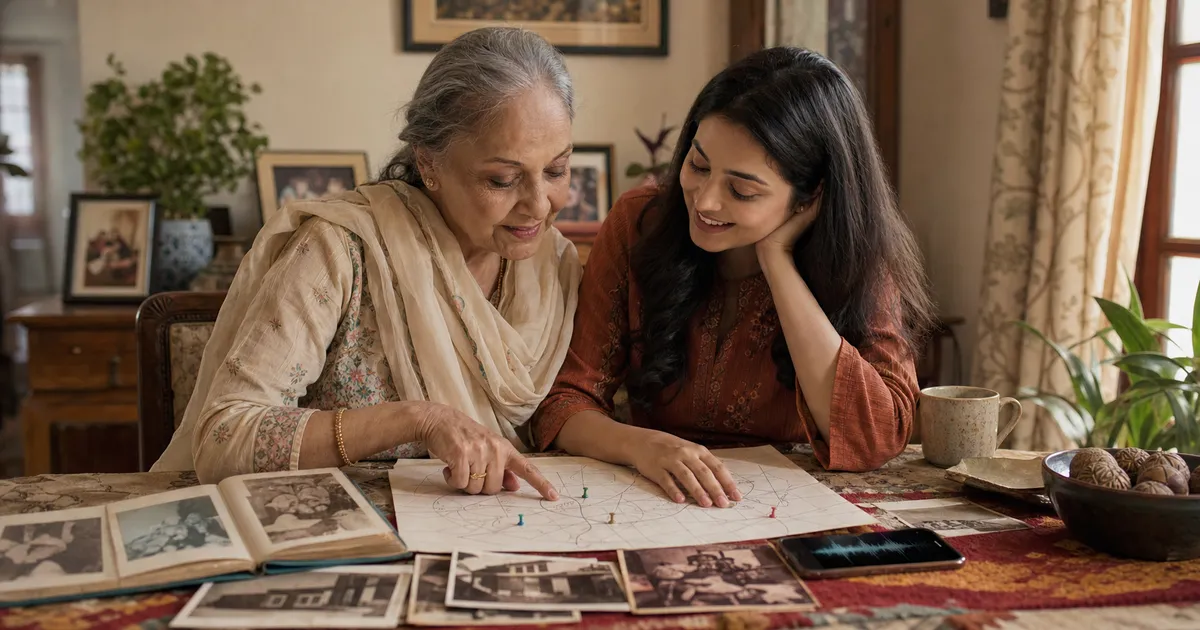
A family memory map gives places their stories. It can connect a childhood courtyard in Lahore, a first flat in Birmingham, a school in Nairobi, or a grandmother's kitchen in Dubai to the voice of the person who remembers it. Instead of presenting family history as a list of dates, a map shows where life happened and why each place mattered.
To make a family memory map, choose one clear theme, list eight to twelve meaningful places, record one story for each place, check names and dates, and attach a photograph, phrase, or sound wherever you can. The finished project can be a paper map, a private digital collection, or a set of family history book pages. It does not need perfect coordinates. It needs the detail that makes a place feel like home.
A map tells you where a family went. A memory map tells you what happened there.
What is a family memory map?
A family memory map is a visual record of the places connected to your family's life. Each point, route, or neighborhood carries a short story from someone who was there. It might include a birthplace, childhood home, school, first job, family shop, place of worship, or the park where cousins met.
Unlike a family tree or migration timeline, a family memory map asks:
- What did this place mean to us?
- Who was there when our family arrived?
- What could you hear, smell, or eat nearby?
- Which event made this location part of our story?
The location can be exact, approximate, or remembered by a local name. "The blue house behind the bakery" may be more useful to your family than a pin placed on the wrong street. The goal is to give future generations a way into the lived experience behind a place name.
Why places bring family stories back
Ask someone about "your childhood" and they may offer a polished summary. Ask what happened in the room where their sisters slept, which road they took to school, or where their mother bought mangoes, and the memory often becomes more specific. A place brings back sequence and atmosphere: the sound of a gate, the shade of a neem tree, the smell of rain on a veranda, or the corner where a family announcement was made.
This is one reason oral history works so well for a memory map. The Smithsonian guide to oral history describes recorded first-person recollections as a way to preserve voices, memories, and perspectives in the speaker's own words. Its practical advice also emphasizes preparation, rapport, open questions, and respect for the narrator's point of view.
For diaspora families, place holds another layer of meaning. A parent may remember a mohalla, village lane, or neighborhood by a name that no longer appears on a modern map. A child may know the airport, apartment, or city where the family started again. Together, these places show that heritage is a chain of ordinary rooms, streets, journeys, and new beginnings.
Choose one story spine before you start
The easiest way to make a family memory map is to give it a single question. Without a focus, every address becomes a possible addition and the project quickly becomes too large to finish.
The places that raised one person
Follow one elder from childhood to the present: their first home, school, neighborhood, first adult home, and current place. This format works well for a birthday or anniversary gift.
The family's route across generations
Trace one branch from village to city to the countries where children and grandchildren grew up. Focus on lived moments, not another list of dates.
The gathering places everyone remembers
Map the locations that made the extended family feel like a family: the house where Eid mornings began, the courtyard where cousins slept on charpoys, or the shop where everyone stopped for chai. It works well as a group project because each person remembers the same place differently.
Choose one story spine, write it at the top of your notes, and postpone anything that does not serve it.
How to make a family memory map in 7 steps
1. Decide who the map is for
Start with the person who will use it: your children, cousins, an elder, or the whole family. The audience tells you how much context to add. A child may need a sentence explaining what a railway platform was like.
Set privacy boundaries now. Name a city without publishing a street address, and describe a family business without sharing private financial details. Decide what is for the immediate family, relatives, or no one else.
2. Make a rough list of places
Ask each contributor to name ten places without arranging them perfectly. Include casual locations too. A bus stop, rented room, school canteen, or neighbor's veranda may carry more weight than a famous landmark.
For each place, note:
- the name the family uses
- the city, region, or country if known
- the person connected to it
- an approximate date or life stage
- one sentence about why it matters
Leave blank spaces. Missing information is a prompt for the next conversation.
3. Give every place a simple story card
Before drawing the map, create one note for each location:
- Place: What did the family call it?
- Time: When was the storyteller there?
- People: Who shared the place with them?
- Scene: What happened there?
- Meaning: Why should the family remember it?
Add a photograph, document, recipe, ticket, or sketch. If there is no image, ask the storyteller to describe the view from the door. A written description can be more intimate than a stock photograph.
4. Record one conversation at a time
Do not ask an elder to explain the entire map in one sitting. Choose one place and one open question. Explain what you are making, who will see it, and that they can pause or stop the recording.
Try prompts such as:
- Tell me about the first room you remember in that house.
- What did you do when you arrived each morning?
- Who would you meet on the way there?
- What did the neighborhood sound like after maghrib?
- Which food, phrase, or household rule belongs here?
- What do you understand about this place differently now?
Let the storyteller answer in Urdu, Hindi, Punjabi, Bengali, Sindhi, Arabic, English, or the natural mix your family uses. Keep the source recording and key phrases when you translate later.
5. Check place names without rewriting the memory
Family memories can contain different spellings, nicknames, changed boundaries, and approximate dates. Keep a distinction between a verified fact and a remembered detail.
Use labels such as "confirmed," "approximate," and "as remembered by Ammi." If relatives disagree, record both versions. A map becomes more trustworthy when it shows uncertainty rather than pretending every memory is exact.
For basic place research, the FamilySearch Place Research Tool provides standardized information, alternate names, historical details, and research links. Use it to clarify a spelling or old name, not to correct the person who lived there.
6. Choose the format that your family will actually use
Choose the format your family will actually use:
- Paper map: Mark locations with numbered pins and keep the story cards beside it. This is lovely for a family room or reunion.
- Private digital map: Add pins with descriptions, photographs, and audio. Keep sharing limited to trusted people.
- Printed story map: Use a simplified map as a visual thread, then give each place a page with its story, translation, and image.
You do not need every route or a sophisticated tool. A hand-drawn neighborhood outline may best represent the place in your family's mind.
7. Connect the map to a lasting archive
Keep the original recording, transcript, translation if needed, story card, and image together. Use clear filenames such as 1968-lahore-school-ammi-urdu.m4a or 1994-birmingham-first-flat-abbu.jpg. Note who recorded the story, when, and any sharing limits.
If the project grows beyond a handful of places, a guided process can help. Qissa's story-gathering process turns warm conversations into a family narrative through recording, transcription, translation, and careful writing. Each place can open a chapter.
South Asian details worth keeping
A map for a South Asian family should have room for the details that formal records tend to flatten.
- Keep the original spelling and pronunciation of names, even when an official record differs.
- Record the family word for a place alongside its current name. It may be known by a market, shrine, school, or nickname.
- Save the language of the memory. A single beta, jaan, dua, or bas karo can show a relationship quickly.
- Include ordinary landmarks: the tandoor, bus route, masjid courtyard, tailoring shop, clinic, or tree where people waited.
- Note who made the place feel safe, difficult, joyful, or temporary. Geography is only half of a family's relationship with home.
- If names or neighborhoods changed, write the storyteller's name first and add a note for younger readers.
These details help a child understand why a place still matters to someone who now lives thousands of miles away.
When a memory is private or contested
Some locations carry grief, conflict, displacement, or family disagreement. You do not have to put every truth on a public map. Ask permission before recording sensitive material and agree on who can hear it. Use a broad description if an exact location feels unsafe.
When two relatives remember a place differently, do not force one official version. Write "Nana remembers" and "Khala remembers" if both accounts matter. Memory is personal evidence, not a courtroom transcript.
Turn the map into a book your family will reopen
A digital map is a useful working tool, but links change and accounts get forgotten. A printed book gives it a stable home, pairing a simplified route with photographs, bilingual text, captions, and the story behind each pin.
You can see how a finished family story comes together in Inside the Book. If you want help turning recordings and notes into a polished narrative, start a Qissa for a parent, grandparent, or yourself. The FAQ covers common questions about languages, privacy, recordings, and family participation.
Frequently asked questions
Does a family memory map need to be geographically accurate?
Make it as accurate as you can, but do not invent precision. Mark a city, village, neighborhood, or approximate route when an exact address is unknown. Label uncertainty clearly.
What if the place no longer exists?
That is often part of the story. Save the old name, describe what stood there, and add a current landmark only if it helps. A photograph, sketch, old letter, or voice description can preserve a place that has changed or disappeared.
Can I make a family memory map when I live abroad?
Yes. Ask relatives to send voice notes, photographs, and descriptions through the family chat. A satellite view or current street photograph can prompt the conversation, but the elder's memory should lead it. Verify details during your next visit.
Begin with one place
You do not need to map an entire family history this weekend. Choose one place everyone knows and ask one person what happened there. Record the answer in the language that feels natural, and write down the name while you can still ask how to spell it.
One pin becomes a story. A handful of stories becomes a map. Over time, the map becomes a way for your children to see that their heritage was not abstract. It happened in kitchens, classrooms, streets, courtyards, shops, and homes, carried forward by people whose voices are still here.
When you are ready to turn those voices into a bilingual family legacy book, start your Qissa. The places may change, but the stories attached to them can stay close.
Read next
Keep building the family archive.
These guides connect the next question, recording habit, or heirloom idea so the archive feels easier to keep building.
September 8, 2026 · 10 min read
How to Preserve Old Family Newspaper Clippings
Learn how to preserve old family newspaper clippings, scan them safely, capture the stories behind them, and build a lasting archive your family can revisit.
August 27, 2026 · 9 min read
How to Preserve Your Family's Old Superstitions and Beliefs
Preserve the stories behind your South Asian family's old superstitions, from the evil eye to lucky charms, before they fade with the elders who hold them.
August 24, 2026 · 8 min read
How to Keep a Grandparent's Memory Alive Forever
When a grandparent passes, their stories risk fading too. Learn how to keep your grandparents' memory alive through family stories, voices, and rituals.
Preserve the voice too