
How to Preserve Old Family Newspaper Clippings
Learn how to preserve old family newspaper clippings, scan them safely, capture the stories behind them, and build a lasting archive your family can revisit.
September 8, 2026 · 10 min read
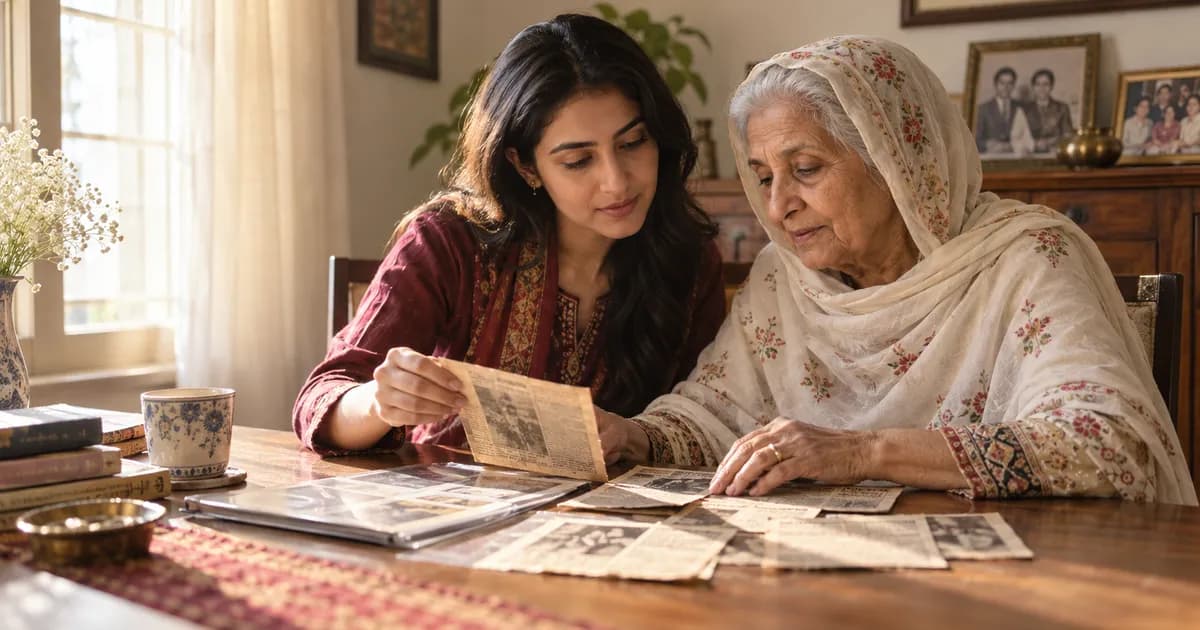
An old newspaper clipping can look ordinary until someone tells you why it was saved. It may announce your parents' wedding, show an uncle receiving a school prize, report the opening of the family shop, or carry a photograph from a community event in Karachi, Birmingham, Toronto, or Dubai. The paper is fragile, but the story around it is often even more at risk.
To preserve old family newspaper clippings, first protect the original from heat, light, tape, and rough handling. Then make a clear digital copy, record the details no headline can hold, and store both the scan and the story where your family can find them. This guide is for diaspora children who have inherited a box, album, or folder and want to keep its meaning intact, not just its paper.
The clipping tells you what happened. The person who saved it tells you why it mattered.
Key takeaways
- Keep original newsprint cool, dry, dark, and separate from photographs and letters.
- Never try to flatten a brittle clipping with tape, glue, lamination, or a heavy iron.
- Scan or photograph the clipping before it becomes harder to read.
- Attach five pieces of context: publication, date, people, place, and the saver’s story.
- Let an elder describe the clipping in the language that comes naturally, then preserve both the original words and a translation.
In this guide
- Why family newspaper clippings need care
- How to preserve old family newspaper clippings
- The story card that makes a clipping useful
- Turn a paper archive into a family legacy
- Frequently asked questions
Why family newspaper clippings need care
Newspaper is not built to last. The U.S. National Archives notes that much newsprint made since about 1850 used wood-pulp paper that can become acidic, yellowed, brittle, and easy to tear as it ages. That is why a clipping that survived in a drawer for 40 years may crack at the fold the first time you try to open it. The National Archives' clipping-preservation guidance is a useful reminder that preserving paper and preserving information are related, but not the same job.
For a family, the information is rarely limited to the printed article. A school prize may have changed what an elder was allowed to study. A cutting about a local cricket match may explain why every cousin still argues over the same team. Treat each clipping as both an object and a doorway.
How to preserve old family newspaper clippings
You do not need a museum setup to make a strong first start. Work slowly, make digital copies early, and stop if the original seems likely to break.
1. Sort before you separate anything
Set aside 20 to 30 minutes for a first look. Keep a clipping with the envelope, scrapbook page, handwritten note, or photograph it arrived with until you understand the connection.
Make three gentle groups:
- Stable enough to scan or photograph now
- Brittle, torn, folded, or stuck down
- Needs a family member to identify it
Write a temporary number on a separate slip of paper, never on the clipping itself. If an item is glued in an album, do not pull it free for the sake of tidiness.
2. Handle the paper as little as possible
Wash and dry your hands, then clear food, drinks, and hand cream from the table. Lift larger sheets with both hands and support them fully. Do not back-fold a clipping to make it lie flat, and do not use tape or glue to repair a tear. The National Archives specifically cautions against those repairs because the paper can break and adhesives can cause lasting harm.
If a piece is already brittle, place it in a clean polyester sleeve large enough to hold every edge. The National Archives guide to family-archive storage recommends one item per sleeve and advises against glues and unknown plastics. The goal is to look at the item without touching it every time.
For a clipping that is crumbling, damp, mouldy, or firmly attached to another object, take a careful reference photograph and consult a paper conservator or local archive before trying any repair. A small pause can prevent a permanent loss.
3. Make a preservation copy before you display it
If the clipping matters mainly for what it says, a high-quality digital copy gives the information a better chance of surviving than daily handling of the original. Use a flatbed scanner only when the paper can rest safely on it. For a fragile, oversized, or bound clipping, photograph it from directly above in bright, even light instead. Avoid auto-feed scanners, which can catch or crease weak paper.
Capture the whole clipping first, including its edges, reverse side, headline, page number, and surrounding notes. Save an unedited master file before making a cropped sharing copy.
Use a clear filename that begins with the date if known. For example:
``text 1978-06-14-karachi-daily-family-shop-opening-front.jpg 1978-06-14-karachi-daily-family-shop-opening-back.jpg ``
Store the master in at least two places that belong to your family, such as a computer and a shared drive that another trusted relative can access. The National Archives also recommends keeping digital copies available to more than one family member. A scan is not a replacement for the original, but it lets everyone read and share the story without repeatedly unfolding the paper.
4. Give the original a quiet, stable home
Keep originals away from sun, heat, dampness, kitchens, lofts, garages, and radiators. The Library of Congress advises that cool, stable storage slows damage to naturally acidic newspaper. Avoid storing clippings directly against letters, photographs, or fabric because newsprint can stain nearby materials.
For a small collection, use acid-free folders or archival sleeves inside a sturdy box. Keep full pages flat where possible. Label the folder or box, not the paper. If you want a clipping on the wall for an anniversary or family reunion, display a print of the scan and keep the original in the dark.
You are giving the past the best conditions to remain readable and recognisable.
The story card that makes a clipping useful
The physical clipping can preserve a date. A story card preserves its human meaning. Before you put an item away, ask one relative to talk through it. A 10-minute voice note over chai can add more value than a beautifully labelled box.
The Smithsonian Institution Archives describes oral history as a way to preserve people’s voices, memories, and perspectives in their own words. Its family oral-history guidance recommends preparation, open questions, and respect for what a narrator is willing to share. Let the clipping be your gentle prompt rather than a test of anyone’s memory.
Use this five-part story card for every clipping:
| Field | What to capture | | --- | --- | | What is it? | Newspaper title, headline, date, page, and a short description. | | Who is connected to it? | Names, family relationship, and the original spelling or pronunciation. | | Where did it happen? | City, neighbourhood, school, workplace, or family home. | | Why was it kept? | The event, feeling, sacrifice, or family milestone behind the paper. | | What should the next generation know? | A direct quote, lesson, family phrase, or memory in the narrator’s own voice. |
Prompts that invite a fuller answer include:
- What do you remember about the day this appeared?
- Who cut it out, and where did they keep it first?
- What happened just before or after the photograph was taken?
- Is there anything in the article that the newspaper got wrong or left out?
- What would you want your grandchildren to understand when they see this?
Do not rush to correct an elder’s wording. If they remember the paper as akhbar wala article or use a family nickname no official record includes, keep that language. Add a clarification in brackets if it helps future readers, but preserve the voice that makes the record theirs.
Turn a paper archive into a family legacy
A box is a good beginning, but an archive becomes usable when it connects papers to people. Create one digital folder per clipping and keep the scan, story card, transcript, translation, and related photographs together.
A clipping about your father’s first job can sit beside a voice note about the bus journey and a paragraph explaining what that salary made possible. The newspaper article becomes evidence; the oral history becomes the chapter. To involve relatives abroad, share a scan in the family WhatsApp group with one focused question, then confirm what can be shared beyond the immediate family.
When you are ready to shape those fragments into something people will actually revisit, Qissa’s story-gathering process helps turn voice notes, memories, translations, and photographs into a coherent narrative. Inside the Book shows how a finished keepsake can give each document its context rather than leaving it in a folder. For a parent or grandparent who has saved a lifetime of small records, you can start a Qissa when the family is ready.
Common mistakes to avoid
- Using tape, glue, or lamination: These can stain, stiffen, or permanently alter fragile newsprint.
- Putting originals in direct sunlight: Display a printed scan instead, even for a short celebration.
- Scanning only the front: The reverse side may contain a date or handwritten note.
- Saving files as “scan 1” and “scan 2”: A clear filename is a kindness to the person who inherits the folder.
- Preserving the headline but not the memory: Record why the family cared while someone can still explain it.
- Assuming every story is for everyone: Ask before sharing sensitive clipping scans or voice notes in a large group chat.
Frequently asked questions
Should I keep the original newspaper clipping after scanning it?
Usually, yes, if it has family meaning and can be stored safely. Keep it in an acid-free folder or suitable sleeve, away from light and other papers. The scan and story card may become the copy your family uses most often.
Can I remove newspaper clippings from an old scrapbook?
Do not force removal. Old glue and paper can tear easily, and the scrapbook layout may carry its own family context. Photograph or scan the page as it is, record what you know about it, and seek professional advice if the clipping must be separated.
What if nobody knows why the clipping was saved?
Save the basic facts you can see, then share a scan with a few relatives and ask one specific question. Mark unknown details rather than guessing.
How do I include newspaper clippings in a family history book?
Use a scan as a visual reference, then place a short caption beside it explaining who saved it, what happened, and why it mattered. Pair it with a first-person memory whenever possible. The Qissa FAQ can help with practical questions about language, recordings, and participation.
Start with the clipping someone always mentions
You do not need to process an entire cupboard in one weekend. Begin with one cutting that already has a story attached to it: the announcement your mother pulls out at every Eid, the school photograph your father keeps inside a book, or the article that made your grandparents proud.
Protect the paper. Make the scan. Ask the question. Write down the answer before it becomes another family detail everyone assumes someone else knows. One carefully preserved clipping can become a vivid page in the story your family passes forward.
Read next
Keep building the family archive.
These guides connect the next question, recording habit, or heirloom idea so the archive feels easier to keep building.
August 31, 2026 · 10 min read
How to Make a Family Memory Map of Your Roots
Learn how to make a family memory map with elder voice notes, meaningful places, photos, and bilingual stories your children can revisit for years to come.
July 22, 2026 · 10 min read
How to Make a Family Time Capsule That Lasts
Learn how to make a family time capsule with voice notes, bilingual letters, photos, and traditions your children can open and understand years from now.
July 6, 2026 · 11 min read
How to Create a Family Tree for Your South Asian Family
Learn how to create a family tree for your South Asian family. Capture names, relationships, and stories across generations before the details fade away.
Preserve the voice too