How to Preserve Family Poems and Ghazals
Learn how to preserve family poems, ghazals, riddles, and spoken verses in their original language and voice, with context future generations can understand.
September 1, 2026 · 10 min read
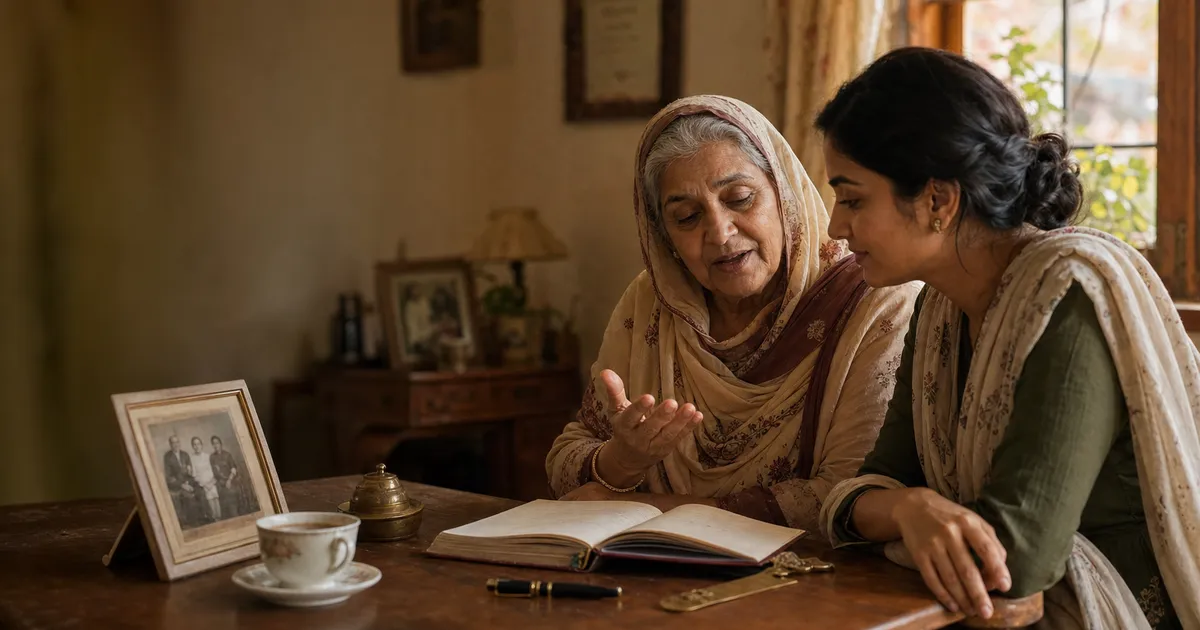
Some families keep their history in folders. Others keep it in the lines an elder recites without looking at a page. Your Dadi may know a sher for every kind of trouble. Your Nana may repeat a doha his own father taught him. An aunt may remember the ghazal that played in the house when she met her future husband. A child may know a silly rhyme that has travelled through four generations without anyone writing it down.
To preserve family poems, you need more than a typed copy. Save the words, the speaker's voice, the language they chose, and the story that gives the verse its place in your family. A good family poetry archive can hold an Urdu ghazal, a Punjabi couplet, a Hindi poem, a Sindhi bait, a Bengali rhyme, a favourite English verse, or a family-made line that exists nowhere else.
The work is intimate and surprisingly simple. Start with one person, one poem, and one unhurried conversation. The aim is not to turn your family into a literary society. It is to keep the lines that have helped people remember, celebrate, mourn, flirt, pray, tease, and make sense of life.
The goal is not to make a family poem sound formal. It is to keep the voice that made it yours.
What counts as a family poem?
Do not limit the archive to poems written by someone in your family. A family poem is any verse that carries family meaning. It might be a famous ghazal your grandfather recited every Eid, a couplet your mother used when you were homesick, or a rhyme your cousins invented on the walk home from school.
Look for:
- Sher, ghazals, folk couplets, dohas, kafis, or regional verses remembered by an elder
- Poems copied into school notebooks or letters, plus original poems and dedications written by relatives
- Riddles and rhymes used with children
- Lines recited at gatherings or connected to a place, season, migration, or particular person
Poem, saying, and song are not always separate in family life. UNESCO lists poems, riddles, proverbs, prayers, and chants as oral traditions that carry knowledge and collective memory. Read its overview of oral traditions and expressions for a wider view of what belongs in a living heritage archive.
Why the voice matters as much as the words
A transcript can tell you which words your grandmother remembers. A recording can preserve how she leans into the first line, where she pauses, and whether she laughs before the ending.
This matters especially for diaspora families. A translation can make a poem accessible to a child in Toronto, Dubai, London, or Melbourne, but it cannot replace the original Urdu, Hindi, Punjabi, Bengali, Gujarati, Sindhi, or Arabic. The mother tongue carries relationships inside the words, evoking a village, schoolroom, or grandmother's kitchen.
Keep both versions. Preserve the original performance, then add a careful transcript and an English explanation for relatives who need one. Do not edit out the pauses or correct every variation. Oral poetry is alive because it changes slightly each time it is spoken.
How to preserve family poems in seven steps
1. Start with one line, not a complete collection
Ask one relative: “What poem or couplet do you still remember from childhood?” That is easier to answer than “Tell me all the poetry in our family.” One line can open a whole room of memories.
Write down the first words they give you, even if the spelling is uncertain. Note who recited the line, its language, and when you first heard it. Investigate the author and wording later. First save the family connection.
2. Ask about the occasion behind the verse
The most valuable part may not be the poem itself. Ask when the person heard it, who taught it to them, and what it meant at the time.
Try gentle follow-up questions:
- Who first recited this to you?
- Where were you when you learned it, and who used it at home?
- Did a parent use it for a particular situation?
- What did it mean when you were young, and what does it mean now?
- Is there a word or pronunciation that must stay exactly as you say it?
The Smithsonian recommends using questions as guideposts, not a script. Its sample questions can help you explore a verse without interrupting the storyteller's path.
3. Record a natural recitation with permission
Use the simplest device your relative already trusts. A phone recorder is enough. Sit somewhere quiet, place the phone on a stable surface, and let the speaker recite the poem more than once if they want to. Do not stop for a mispronounced word, a cleared throat, or a short story first. Those details are part of the performance.
Before you begin, explain what you are recording, who will hear it, and whether it may be edited, printed, or shared outside the family. Ask for clear permission. If the poem is private, mark the recording as private and keep it that way.
The Oral History Association's best practices emphasise consent, clear expectations, quality recordings, and a preservation plan. Your relative is a collaborator who should understand what will happen to their words.
4. Keep the original language beside the translation
If you cannot read the original script, record the sound first. Write a Roman Urdu or Roman Hindi version as a working aid, then ask a trusted reader to check the spelling. Do not make perfect calligraphy a requirement for beginning.
When you add English, label the kind of translation. A literal translation helps a reader study the words. A poetic translation helps them feel the mood. A short family note may be better than either: “This is the line Dada said whenever someone was leaving for a long journey.”
Keep place and people names in the form your family uses. If a village has more than one spelling, record the alternatives. Future relatives may search for any of them.
5. Capture variations instead of forcing one official version
Your mother may remember one ending, while her sister remembers another. An elder may say that the wording changed after the family moved from Lahore to Birmingham. These differences are not failures. They show how memory travels.
Save each meaningful version with the speaker's name. If you know the published author, credit them. If the source is uncertain, write “family attribution unknown” rather than presenting the line as original.
For poems still protected by copyright, avoid publishing the full text online unless you have permission. You can preserve a private family recording, record the title and author, and write about why the poem matters without reproducing every line publicly.
6. Build a small, findable archive
Give every item a consistent file name. For example:
``text 2026-09-01-dadi-urdu-ghazal-recitation-01.m4a 2026-09-01-dadi-urdu-ghazal-transcript.txt 2026-09-01-dadi-urdu-ghazal-context.md ``
The context note should include the speaker's name and relationship, date and place, language, title or first line, known author, people mentioned, and access restrictions. Add a notebook or gathering photograph if the family is comfortable with it.
Keep the original audio file, make a second copy elsewhere, and review the files yearly. The Library of Congress's cycle of identifying, deciding, organising, and making copies works well for recordings too. Read its digital preservation guidance.
7. Give the next generation a way in
An archive that only one adult can open is easy to forget. Make a short listening session for children. Let them choose one poem, hear the recording, and ask the speaker about a word they do not understand. Invite them to write the line in the family language, draw a scene from the story, or record their own introduction.
Do not test pronunciation or turn the moment into a language lesson. The point is relationship. When a child hears an elder laugh after a line, the poem becomes something lived rather than something assigned.
What to include in a family poetry archive
For each poem, save a small “poem card” with:
- The first line or title
- The speaker, relationship, language, and script
- The audio recording and transcript, if possible
- A literal translation or short meaning note
- The story of when and where it was used
- The known author, connected people or places, and any uncertainty
- Consent and sharing instructions
This turns a loose recording into a resource someone can find twenty years from now, with an answer to “Whose voice is this?” and “Why did this line matter?”
Turning a poetry archive into a family heirloom
Digital files protect access, but a physical book gives the collection a home. A family poetry book might pair an elder's portrait with the first line they remember, its story, the original-language text, an English translation, and notes from younger relatives.
Qissa helps families turn guided conversations, photographs, and spoken memories into a finished narrative. You can see how the story-gathering process works if you want a patient structure for collecting several poems without making an elder feel interviewed for an exam. The inside of a Qissa book shows how spoken memories can be shaped into a keepsake while keeping the family's language and character close.
The editorial work should clarify, not replace, the original voice. Keep the audio, source language, and explanation that makes the poem yours.
Frequently asked questions
Do I need to read Urdu or another heritage script?
No. Start by recording the pronunciation and writing down what you can hear. Ask a relative, teacher, community member, or professional translator to help verify the text later. An imperfect first record is more valuable than a perfect record that never gets started.
What if my relative cannot remember the whole poem?
Save the fragment. Ask whether a first line, last line, rhythm, or associated story brings anything else back. Do not pressure the speaker to perform. A partial verse with the speaker's voice and context is a meaningful family record.
Can I include a family poem in a printed book?
Yes, if it is original to your family or you have the rights needed for the use. For well-known poems, consider including the title, author, a short permitted excerpt, a recording of your relative discussing it where appropriate, and the story of why it belongs in your family. When in doubt, keep the full text in a private archive and seek permission before public distribution.
Begin with the line you can still hear
Tonight, ask one elder to recite the poem, couplet, or rhyme they would never want the family to forget. Record it with permission. Write down who taught it to them. Ask what was happening in their life when the words became important.
That is already a family poetry archive in miniature. The rest can grow slowly, in the language that feels natural, through conversations that sound like your family. If you want help shaping those recordings, translations, photographs, and memories into a book your relatives can hold, start a Qissa. One day, a child in your family may open it and hear not just a poem, but the voice that made it home.
Read next
Keep building the family archive.
These guides connect the next question, recording habit, or heirloom idea so the archive feels easier to keep building.
May 29, 2026 · 8 min read
Keep Your Mother Tongue Alive Through Family Storytelling
Diaspora parents worry their kids will lose their mother tongue. Here is how family stories can help keep Urdu or Hindi alive across generations.
September 6, 2026 · 10 min read
How to Interview Grandparents Across a Language Barrier
Learn practical ways to interview your South Asian grandparents across a language barrier, preserving their voice, heritage stories, and immigrant wisdom.
August 31, 2026 · 10 min read
How to Make a Family Memory Map of Your Roots
Learn how to make a family memory map with elder voice notes, meaningful places, photos, and bilingual stories your children can revisit for years to come.
Preserve the voice too