Why Family Stories Matter — The Science Behind Preserving Your Heritage
Research shows that children who know family stories have higher self-esteem and resilience. Here is why preserving your family's stories is one of the most important things you can do.
May 16, 2026 · 8 min read
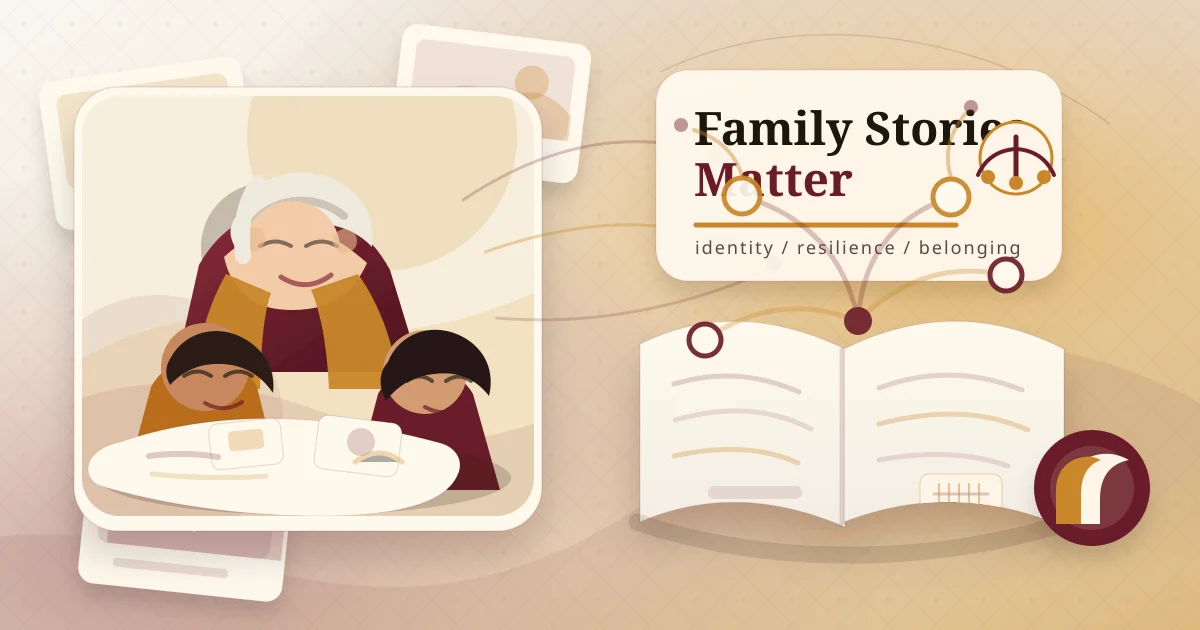
There is a quiet urgency that many diaspora families feel but rarely put into words. It is the sense that something is slipping away — not possessions or property, but the stories that made the family feel like itself. The way Dadi describes the monsoon in Lahore. The recipe Nani never measured. The migration story that was only ever told during late-night phone calls.
Most people know, instinctively, that these stories matter. But the reason goes deeper than sentiment. Decades of psychological research, sociological studies, and neuroscience have shown that family stories are not just nice to have. They are foundational to how children develop identity, resilience, and a sense of belonging.
The research behind family storytelling
In the early 2000s, Dr. Marshall Duke and Dr. Robyn Fivush at Emory University conducted a landmark study on family narratives. They developed what they called the "Do You Know?" scale — a set of twenty questions that measured how much children knew about their family history. Questions like: Do you know where your grandparents grew up? Do you know how your parents met? Do you know about an illness or tragedy in your family?
The results were striking. Children who knew more about their family history had:
- higher self-esteem and a stronger sense of control over their lives
- better family functioning and lower levels of anxiety
- greater resilience when facing adversity
- a clearer sense of their own identity and place in the world
The researchers concluded that children who grow up with what they call an "intergenerational self" — a sense that they belong to something larger than themselves — are better equipped to handle stress, loss, and uncertainty. Family stories provide a framework for understanding that life includes both good times and hard times, and that the family has survived both.
For South Asian families spread across continents, this research carries even more weight. When children grow up in London, Toronto, New York, or Sydney, far from the neighborhoods their grandparents knew, family stories become the bridge between two worlds.
What family stories actually do
Family stories are not just information. They serve specific psychological and cultural functions that no textbook, documentary, or history class can replicate.
They create identity
A child who hears that their great-grandfather walked across the border in 1947 with nothing but a small bag and a letter of introduction carries that story differently than a child who only reads about Partition in a history book. The first version is personal. It says: this happened to us, and it is part of who you are.
Identity is not built from facts alone. It is built from the stories that connect those facts to the people who lived them.
They build resilience
Family stories that include hardship — migration, loss, starting over — teach children that difficulty is survivable. When a grandchild hears that their Nani rebuilt her entire life in a new country, learned a new language, and raised three children while working full-time, it changes how they think about their own challenges.
Dr. Duke's research found that the most effective family stories were not just the happy ones. Children benefited most from what the researchers called "oscillating narratives" — stories that acknowledged both struggle and survival. The message is not that life is easy. The message is that the family endures.
They preserve culture
Every family has its own small culture: the way food is prepared, the phrases that get repeated, the jokes that only make sense within the family, the rituals that happen on certain days. When stories are not preserved, these cultural fragments disappear quietly. No one notices they are gone until the person who carried them is no longer there.
For immigrant families, this loss is compounded. The children may not speak the language fluently. They may not know the songs, the prayers, the recipes. Family stories become the vessel through which cultural knowledge survives — even in translation.
They strengthen family bonds
When a family gathers and someone tells a story, something shifts. The room gets quieter. People lean in. Even teenagers who usually have their phones out start paying attention. Storytelling creates a shared experience that no amount of group chatting can replicate.
Families that tell stories together report feeling closer, more connected, and more satisfied with their relationships. The act of listening to a family story is itself an act of belonging.
The problem: stories are disappearing
Despite the evidence, most families are not preserving their stories. There are several reasons for this, and they are all understandable.
Elders do not always want to talk about the past. Some memories are painful. Some stories feel too big to start telling. Many grandparents worry that their stories are not interesting enough to record.
The younger generation does not always know how to ask. A common mistake is to sit down with a parent or grandparent and say, "Tell me about your life." That is too broad. Most people do not know where to begin with a question that large.
Families are geographically scattered. When cousins live in five different countries and grandparents are in another, the natural opportunities for storytelling — Sunday dinners, holiday gatherings, long car rides — simply do not happen as often.
Technology makes it feel complicated. There are apps, platforms, recording equipment, transcription services. The abundance of options can make the process feel overwhelming, when what most families actually need is something simple and familiar.
This is the gap that Qissa was built to fill. The process starts with a warm onboarding call, followed by recorded phone or Google Meet sessions with a Qissa Story Guide. The storyteller speaks in English, Urdu, or Sindhi at their own pace; then the guide and a professional writer shape those memories into a hardcover book. You can see the full journey on how Qissa works.
How to start preserving your family stories today
You do not need a studio, a microphone, or a list of fifty questions. You need one conversation.
Start with one specific memory
Instead of asking for an entire life story, ask about one moment:
What did your first day at school feel like?
>
What is the funniest thing that happened at your wedding?
>
What did your mother's kitchen smell like on a Sunday morning?
Specific questions produce specific answers, and specific answers are the ones that stay with you.
Use the channels your family already uses
If your grandmother knows how to send a voice note on WhatsApp, that is the best tool. If your father prefers email, send prompts that way. If a phone call feels more natural, schedule one. The goal is not to use the most advanced technology. The goal is to make the process feel like a normal part of the family's routine.
Record the voice, not just the words
Written transcripts are useful, but the voice carries something that text cannot. The pauses, the laughter, the switch between languages, the way a story changes tone when the storyteller gets to a certain part — these details make a family story feel alive. With the storyteller's approval, Qissa can privately link selected audio beside the printed story. You can preview the format on Inside the Book.
Make it a habit, not a project
The families that succeed at preserving their stories are not the ones that plan an intensive interview weekend. They are the ones that make storytelling a regular, low-pressure habit. One prompt a week. One voice note in return. Over a year, that is fifty-two stories — enough for a book.
Why this matters now, specifically for South Asian families
The generation that lived through Partition, migration, and the early years of diaspora life is aging. These are the grandparents and great-grandparents who carry the most direct connection to the places, languages, and traditions that shaped the family. When they are gone, the stories do not just become harder to collect. They become impossible.
This is not meant to create guilt. It is meant to create clarity.
The diaspora children who are now in their twenties, thirties, and forties are at a unique moment. They are old enough to understand what is at stake, and young enough to still have time to act. They are the bridge generation — the ones who can ask the questions in English and receive the answers in Urdu, Hindi, Punjabi, or Arabic. They are the ones who can turn those answers into something the next generation can read, hear, and understand.
If you are ready to start preserving your family's stories, start a Qissa for a parent, grandparent, elder, or yourself. The process begins with one conversation, and the result is something your family will hold for generations.
Read next
Keep building the family archive.
These guides connect the next question, recording habit, or heirloom idea so the archive feels easier to keep building.
May 5, 2026 · 4 min read
What Is a Family Legacy Book?
A family legacy book preserves the stories, voices, photos, language, and memories that make your family feel like itself.
June 22, 2026 · 10 min read
South Asian Naming Traditions: Stories in Your Family Name
South Asian names carry generations of history. Discover the naming traditions that shaped your family and how to preserve the stories behind them before they fade.
May 16, 2026 · 10 min read
Meaningful Gifts for South Asian Parents Who Have Everything
Struggling to find meaningful gifts for South Asian parents and grandparents? Discover why preserving their stories is the most emotional and lasting gift you can give.
Preserve the voice too